01 introduction
How a predictive incentive tool replaced days of manual research with a four-input flow, giving building owners, engineers, and financial teams clear answers about energy efficiency savings in under five minutes.
Category
Product Design
Client
Climate Tech Startup
Year
2023
Services
UX Research
Interface Design
Data Visualization
02 Problem Space
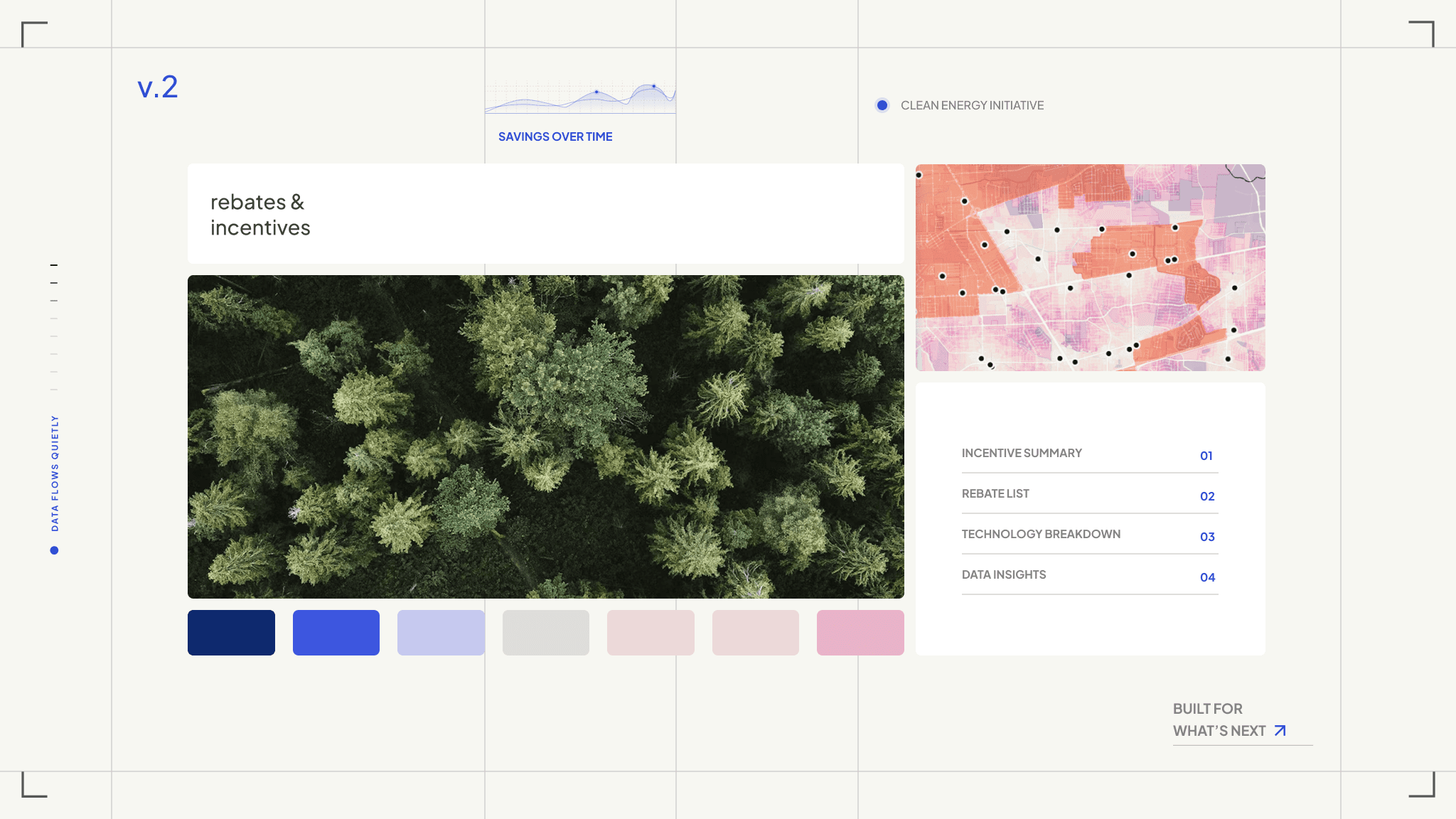
Hundreds of energy efficiency incentives exist across US federal, state, and utility programs. Most building owners have no idea what they qualify for. The data lives in fragmented databases, each with different eligibility criteria, and three user groups need it differently.
Enterprises want ROI and payback period. MEP engineers want product-level detail for client pitches. Green banks want to compare programs for investment decisions. The process of determining eligibility was entirely manual, requiring days of research across disconnected federal, state, and utility sources with no unified view of potential savings.
The pain points were layered: rebate data varied by state, city, and utility provider with no consolidated view. Inputting building information was cumbersome. And users could never get a clear picture of which incentives they qualified for or how much they would actually save across different technologies like HVAC, lighting, insulation, and controls.
03 Data Mapping
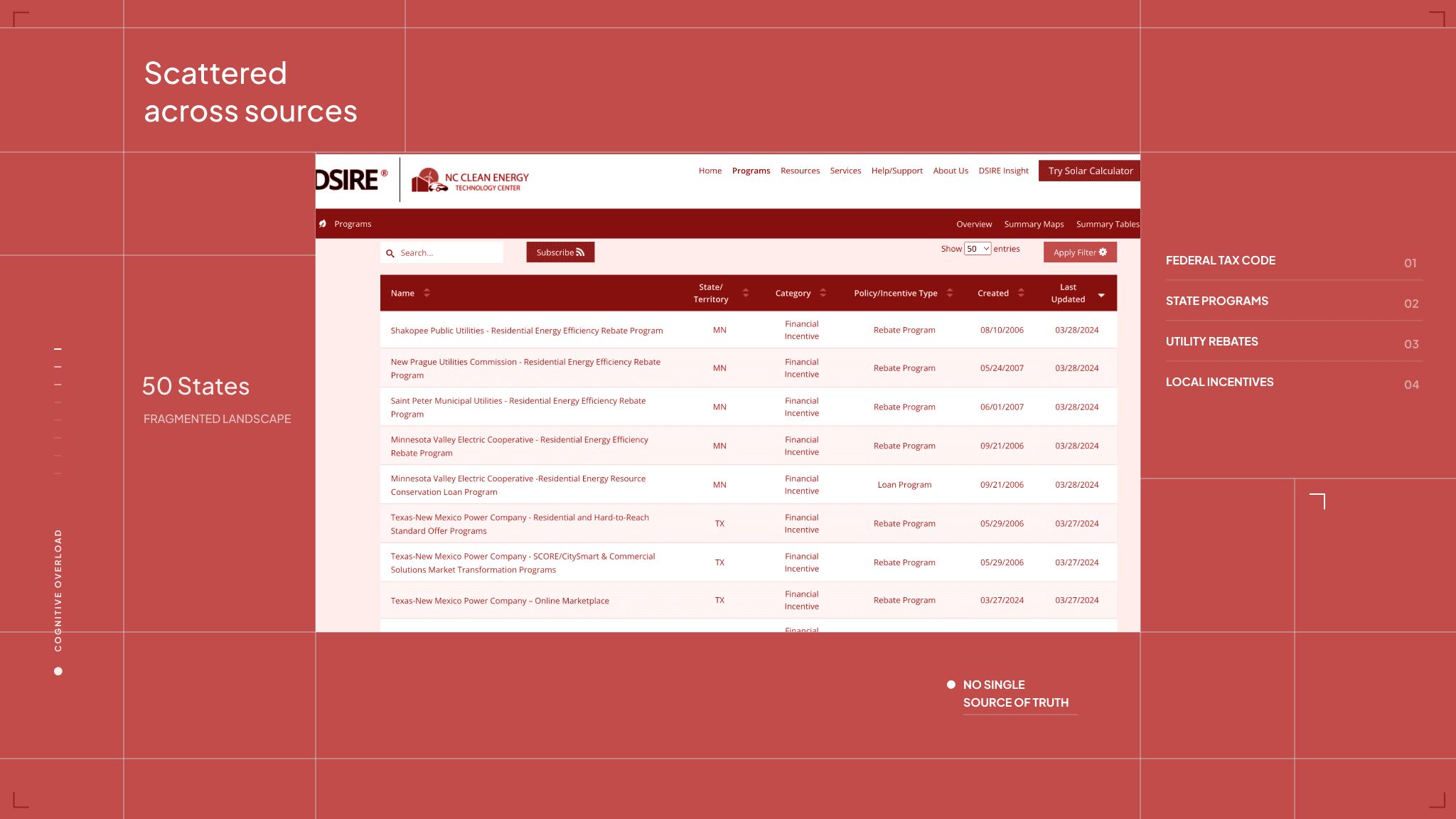
The first step was mapping the incentive structure: federal rebates like IRA Section 179D, state-specific programs, and utility incentives from providers like PG&E and SCE. I traced how user inputs filter the DSIRE database to produce estimated savings.
"Users don't need to understand the database. They need one question answered: what am I eligible for, and how much will I save?"
the core challenge
Three user groups. One interface. Hundreds of variables. No existing tool that made the data accessible without specialist knowledge.

04 The Solution
Users enter four things: building area, address, utility provider, and year built. The system handles everything else.
summary view
"What am I eligible for?"
Total estimated savings at a glance, broken down by federal, state, and utility incentives and by technology type. The entry point for all three user segments.
eligibility details
"Why do I qualify?"
Every number shows its calculation. Trust comes from showing the math.
financial metrics
"What's the return?"
ROI, payback period, and net operating income alongside technology comparisons. The layer enterprises and banks drill into for decisions.


05 Design Decisions

06 Impact
research time
Replaced days of manual research with a five-minute flow using just four inputs.
user segments
One interface, three user segments.
data clarity
Transparent calculations let users verify every number, building trust in the tool's recommendations.
v1 scope
V1 launched covering California's commercial building market across five utility providers.
trust
Every incentive shows its eligibility criteria, calculation method, and source.


07 reflection
I would scope V1 even tighter if I did it again. California with five utility providers was already a substantial surface area. Starting with a single provider and refining that experience before expanding would have let us learn faster. The deeper lesson was about designing for technical domains: the designer's job is not to simplify the data itself, but to simplify the experience of reaching it. MEP engineers need the complexity. The key is giving everyone a clear entry point and letting them go as deep as they choose.